Identify Burnout with the BRAAINS Framework™
For as long as I can remember, society has framed burnout as a sign of weakness. The story of burnout is often presented to us as a personal failing, and yet it shows up in every area of our workplaces and even society. If it's recurring and the phenomenon is widespread, it's clear that burnout is due to environmental factors that actively work against your brain and nervous system.
And let me tell you, not only from personal experience but also from professional observation, most people are never told that burnout isn't their fault. More often than not, we're told that all we need are better time management skills. Or even worse, endure the harm so that we're rewarded with that raise or promotion that rarely ever comes.
So here's a thought: maybe the problem is the system you're operating within. Maybe, just maybe, the problem isn't you.
Burnout isn't a condition that happens at random. It happens when a few core systems in our environment stop functioning in ways that benefit our nervous system. When those core systems are corrupted, our brain pays the ultimate price and shows up as mental, physical, and emotional exhaustion.
After working with burnout patterns, I started noticing something. Every aspect of most organizations is not broken. But instead, there are specific core factors that contribute to burnout.
Want to know which system is breaking down for you?
Take the 2-minute BRAAINS Audit → Download Here!
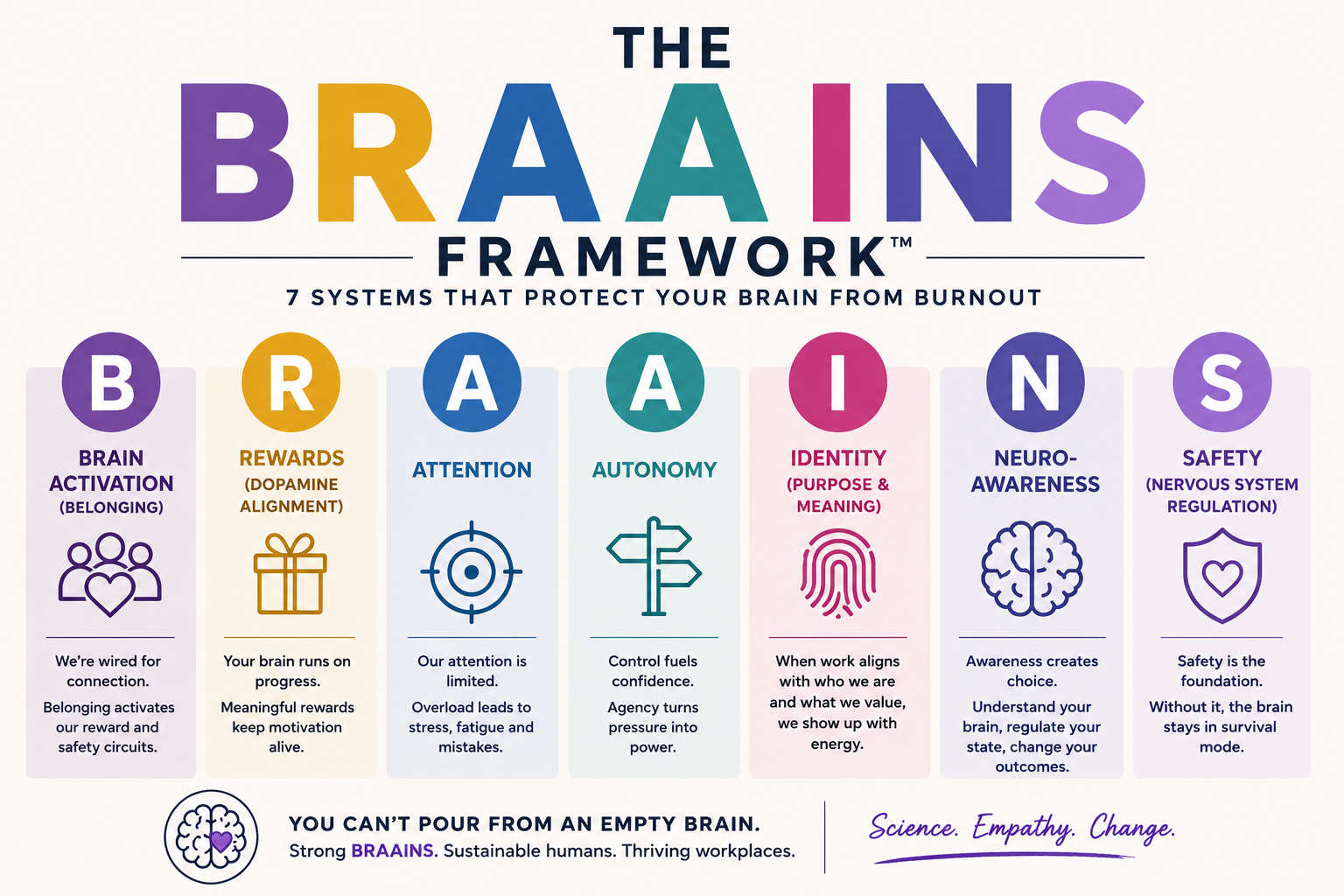
The BRAAINS Framework™
B — Brain Activation (Belonging)
Our brains are evolutionarily primed for human connection. When we feel a sense of belonging, whether at work or in our personal lives, everything seems to function much better than not. You not only feel better, but you think more clearly and have the ability to regulate your emotions.
But what happens when you don't have a sense of belonging?
Depending on who you are and how you operate in the world, it can affect you in many different ways. But ultimately, you disengage from the tasks and people around you. To be completely candid, you almost completely shut down mentally, emotionally, and sometimes behaviorally. The truth here is that burnout doesn’t always look like exhaustion or overwhelm. Sometimes it looks like a disconnection from ourselves, our people, and our work.
R — Rewards (Dopamine Alignment)
Your brain isn't interested in how much effort or time is spent on a project or task. It understands progress in the form of reward. The dopaminergic system gives us that feeling of accomplishment when receiving a reward for an effort. It's very cause and effect.
When our work isn't recognized for its worth, there's no signal to the brain that progress was made. If our work doesn't feel fulfilling or seems to be invisible to others, it takes a toll on motivation. So, then you start to ask yourself, what's the point?
A — Attention
Our cognitive load dictates how we perform at work and in the world. When there's a cognitive overload, emotional regulation evaporates, and toxic environments arise from the residue. Every day, we perform tasks that seem mundane enough not to have an effect on our well-being. Constantly switching between multiple emails, various meetings, and endless direct messages ever so slowly erodes your energy. By the end of your day, you’re more than just tired. You're more than just exhausted. You're mentally fried, and that's biologically significant.
A — Autonomy
Having a sense of control over yourself is a lot more important than many people realize. When we feel as though we have no control over our work or over our bodies, chronic stress builds upon itself, you experience sustained energy loss, and an inner frustration begins to smolder.
You can't quite put a name to it, but you feel that something is off.
If there’s one thing that will almost always cause people to break, it’s micromanagement. Micromanagement signals to people that you do not trust them to complete the tasks assigned. And if that’s the case, why did you hire them in the first place? When someone is constantly looking over your shoulder, triple-checking your work, and requiring that you ask permission to complete tasks you were hired to do, it's bound to feel exhausting.
Lack of agency is a key driver of burnout that’s often missed.
I — Identity (Purpose & Meaning)
If we refer to Maslow’s hierarchy of needs, it’s clear that people don’t burn out from work. Work (in some form or another) is an essential aspect of living and leading a fulfilling life. So when someone tells you that people burn out because they work too much, that’s not the entire story.
Workplace burnout happens when we have a values and identity misalignment. If our work does not fit into our identity, it causes friction. If you’re asking yourself, “Do my values align with this environment?” And the answer isn’t an energetic and enthusiastic yes, then you have your answer.
Misalignment of personal identity and the work that you do amplifies your tasks and makes everything feel much heavier. The work becomes more difficult to complete by the day. And these are tasks that you’ve completed many times. The problem is not that they are hard to complete. The problem is that they feel pointless without alignment.
N — Neuro-awareness
Sometimes words that remind us of high school biology seem intimidating, but don’t let this one scare you. Neuro-awareness provides us with the tools to recognize burnout signs early. And just like cancer, catching it early is the best way to ensure that burnout does not spread.
If you can recognize burnout early on, then you can take action to address signs that indicate chronic overwhelm or cognitive overload. Because the truth is that no one teaches us to pay attention to signals from our nervous system lets us know when rest is required.
If anything, most of us have been told to just keep pushing. The brain is most recognized for progress. An overloaded nervous system signals stagnation and an eventual crash.
S — Safety (Nervous System Regulation)
Safety is the non-negotiable foundation of the BRAAINS framework. From physical to psychological safety, the nervous system is taking notes whether we can identify it or not.
Survival mode causes your brain to forgo using its prefrontal cortex and regress into the limbic cortex, where the amygdala lives. That’s your fight, flight, fawn, or freeze response center.
When stress remains in an elevated state for a prolonged period of time, performance inherently drops into oblivion. Think about it, can you hold a full glass of water while shaking intensely without spilling anything or without making some sort of mess?
Simply put, your brain can’t work when it’s constantly under imminent threat.
Adding it all
The next time you think to yourself, “Am I burned out?” Or maybe when you hear your coworker screaming into a paper bag in the cubicle next to you, instead:
“Which part of their BRAAINS system is broken?’
Because everything doesn’t have to be broken in BRAAINS. Sometimes it’s one or two areas of improvement.
Other times, there’s a need for a full system reinstallation, full of sustainable upgrades. We don't fix burnout by pushing harder. That only amplifies the nervous system, interpreting your work or life as a threatening situation.
You improve and fix burnout by addressing the system your brain is doing its best to survive within.